

What Sierra is
Sierra sells a deceptively simple proposition: customer experience becomes an agent that can talk, remember, and act, across channels, without turning every change into an engineering project. Sierra frames this as building a single AI agent once and deploying it everywhere, across chat, voice, email, SMS, contact center, and even distribution surfaces like ChatGPT.
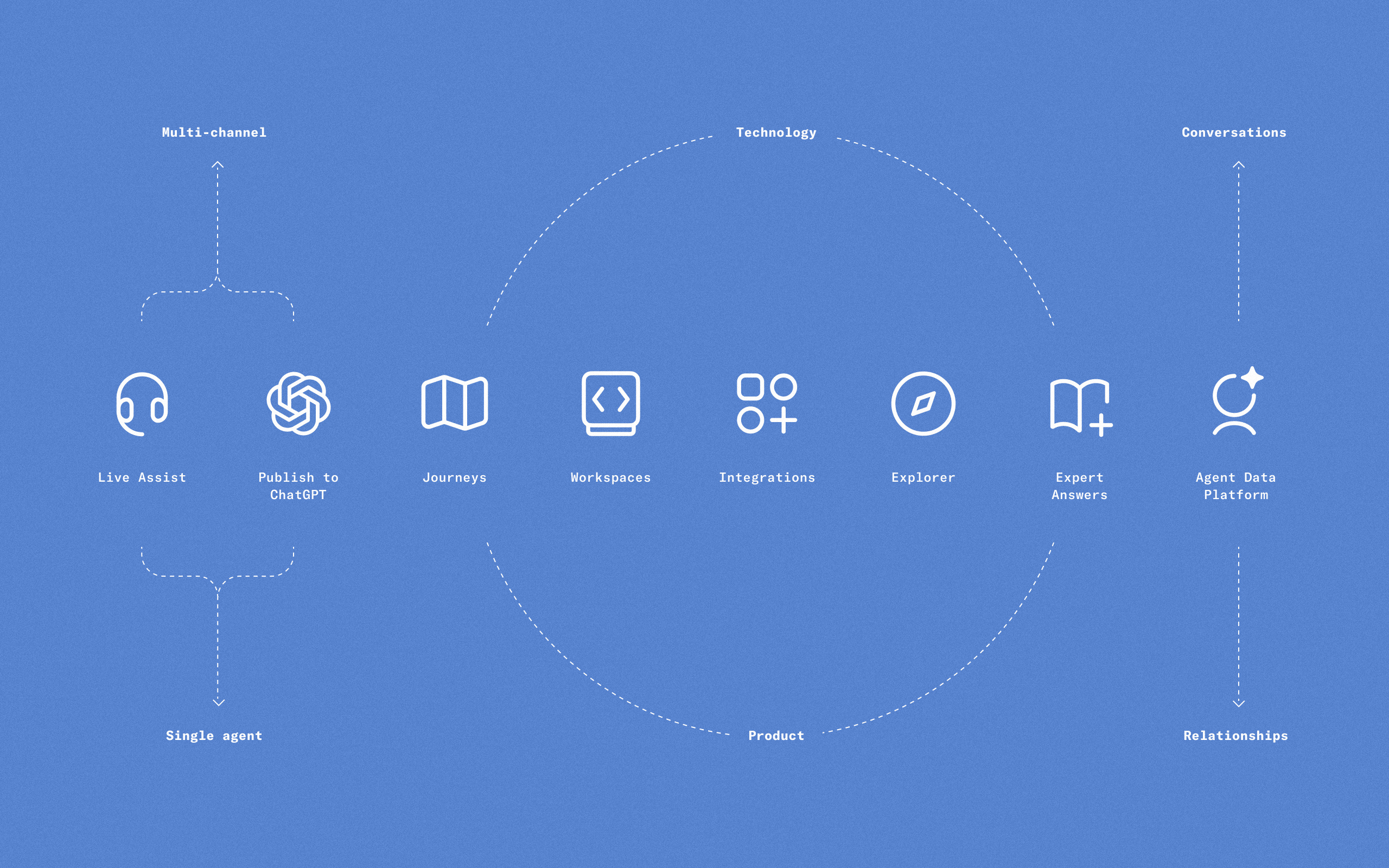
Where many chatbot products stop at answer retrieval, Sierra’s positioning is enterprise-grade customer journeys: policy-following workflows, integrations into systems of record, and reliability controls designed to survive real customers and real edge cases. It’s product surface includes:
Agent Studio / Agent Studio 2.0 (collaborative, no-code-ish agent building with Journeys + Workspaces + Integrations)
Agent SDK (deeper developer control)
Insights 2.0 (diagnose + optimize at scale)
Live Assist (real-time co-pilot for human associates, using the same knowledge/guardrails as the agent)
Voice (phone channel, with Sierra’s own testing/simulation features)
Agent Data Platform (ADP) (memory/context layer intended to unify conversations with structured customer + business data)
Trust & reliability posture (compliance targets + security practices)
The upshot here is that Sierra is trying to be the operating system and tooling for applied, production customer agents, with value measured in resolutions, retention, and conversion.
Headline traction
They launched in February 2025 and reached $100M ARR in 7 quarters, then raised $350M at a $10B valuation, and described a customer base skewed toward large enterprises which are over 20% of customers with revenue of >$10B; over half >$1B. These implies that Sierra already scaled to a meaningful enterprise software run rate, with investors underwriting a long runway.
Sierra was co-founded by Bret Taylor and Clay Bavor, who previously worked together at Google; Taylor has held roles including Co‑CEO of Salesforce, CTO of Facebook, and co-creator of Google Maps; Bavor led Google Labs and earlier initiatives like Google’s AR/VR efforts, Project Starline, and Google Lens.
The product thesis: the conversation is becoming the interface
Sierra’s worldview:
Multi-channel → single agent (chat/voice/email/SMS/contact center, plus distribution via ChatGPT/Gemini)
Technology → product (agent building becomes accessible beyond engineers; “simple, not simplistic”)
Conversations → relationships (memory/context via ADP; move from one-and-done tickets to continuity
This thesis is strategically important because it tries to reframe the category. If Sierra is right, the winning product is a durable system of record for customer intent + actions. That starts to look like platform software.
Architecture choice: many models, not one “god model”
Sierra’s “constellation of models” architecture:
It uses 15+ models, each specialized for tasks like language detection, sentiment analysis, knowledge retrieval, response generation, summarization, tool selection, and post-processing.
A set of “supervisors and monitors” evaluate and refine outputs at each step for quality and safety.
Sierra is building a system where performance comes from decomposition into smaller tasks, redundancy + monitoring, and continuous evaluation and improvement loops. An engineering worldview that tends to compound because the more conversations you run, the more you learn what breaks.
Business model: outcome-based pricing as incentive design
Sierra explicitly argues that AI agents enable a new pricing model: outcome-based pricing, where you pay for tangible business results (e.g., resolved conversation, saved cancellation, upsell/cross-sell), and often no charge if unresolved.
They frame the evolution as:
traditional fixed pricing (seats / flat rate) → waste (“shelfware”)
consumption-based pricing (usage-based infra)
outcome-based pricing (value delivered)
What could be durable here?
Switching costs through workflow embedding
Sierra aims to integrate into knowledge bases and internal systems, contact centers, multi-channel deployments (chat/voice/email/SMS), and “memory” via ADP (unified conversation + structured data). Once an enterprise agent is trained on policies and tone, connected to billing, identity, inventory, etc, monitored for compliance and escalations, and measured against outcomes, switching could feel like replacing an entire operating system.
Data advantage
Sierra’s ADP pitch is essentially: we’ll unify unstructured conversation logs with structured business data. This looks like having better labeled feedback loops tied to outcomes. With outcome-based pricing, the data becomes naturally labeled: resolved vs not, saved vs lost, converted vs bounced.
Competition: Where Sierra sits in the stack
Sierra is competing on two fronts at once:
Enterprise CX software incumbents embedding AI (CRM/contact-center ecosystems)
AI-native agent platforms aiming to own agent orchestration, evaluation, and deployment
Sierra’s differentiation:
we are built for enterprise grade reliability and compliance
we provide a unified agent across channels including voice
we productize building + release management (Workspaces, snapshots, rollback)
A competitive risk is that incumbents own distribution (existing contact center seats), and hyperscalers own infrastructure economics. Sierra needs to justify why it is not just a feature layer that gets competed to zero.
But the best defense is compound product advantage: reliability, governance, measurement, and domain tooling that becomes hard to replicate quickly. Sierra is currently allocating product effort to:
channel coverage (voice + chat + contact center)
builder tooling (Agent Studio 2.0 + Workspaces + Integrations)
optimization tooling (Insights 2.0)
human augmentation (Live Assist)
data/memory layer (ADP)
What Sierra appears to be building toward
If Sierra’s thesis holds, the company is aiming for something like:
a customer experience system-of-record (agent + memory + integrations)
plus an optimization engine (Insights, continuous improvement, evaluation)
plus a human augmentation layer (Live Assist)
plus distribution connectors (ChatGPT / contact center / multi-channel)
In other words, Sierra wants to become the layer where enterprises encode “how we treat customers,” and then let AI execute and improve it.
That is an ambitious but coherent platform strategy.