

Codex is OpenAI’s bet that the next interface for software development is delegated work: a coding agent that can run tests, open PRs, and operate across the SDLC in sandboxed environments, while you steer.
Codex is simultaneously (1) a distribution wedge for ChatGPT paid plans, (2) a bridge back to API consumption via credits and developer org linking, and (3) a defensive moat-builder against IDE-native incumbents by shipping agentic workflows (parallel tasks, code review, repo-aware edits) that pure in-editor autocomplete struggles to match. OpenAI reports that Codex was used by over a million developers in the past month, and that usage doubled after GPT-5.2-Codex shipped in December last year.
What will matter over the next 12–24 months: tight iteration on the agent loop (latency, reliability, evaluation-driven improvements), enterprise-grade governance (data controls, auditability, policy), and an ecosystem flywheel where reusable skills (MCP) and automations become the new plugins, portable, composable, and team-shareable.
A mission that insists on deployment
OpenAI is a research-and-deployment company building AI systems so that artificial general intelligence benefits all of humanity. The company’s public identity is a tension between research lab and product company, and Codex makes that tension legible: it is research (specialized coding models + agent-loop design) deployed as an everyday tool that changes how people ship software.
Codex’s best mission translation is the promise that more people can build safely, faster, and that capability is distributed (CLI, IDE extension, web, desktop) rather than trapped in a single tool.
The coordination tax
Software development is already a coordination problem (specs, context, reviews, tests, deployments). As code generation got cheap, the bottleneck shifted to: (a) understanding a large codebase, (b) executing multi-step changes across files, (c) verifying changes (tests, CI), and (d) review and safety. The pain is shipping a change reliably.
Today’s stack is a patchwork:
IDE autocomplete/chat (fast, but shallow, often single-file and short-horizon).
Scripted automation (reliable, but brittle; requires upfront engineering).
Offshore/contract work (scales effort, not iteration speed).
AI code review bots (useful, but rarely repo-native or test-executing).
Shortcomings concentrate in three failure modes:
Context collapse: tools see a snippet, not the system.
Verification gap: suggestions aren’t executed against tests/CI by default.
Governance gap: enterprises need audit trails, sandboxing, and policy boundaries.
Delegated work, supervised
Codex’s aha moment is that coding assistance becomes meaningfully more valuable when it can (1) execute, (2) verify, and (3) coordinate, not just suggest. So Codex wraps a specialized model inside an agent loop that can read a repo, run tools/tests, and iterate until a task is done.
Codex differentiates by being safe-by-default and lifecycle-aware:
It runs in sandboxed environments (cloud or local), constraining risk while still letting it touch the code.
It is designed for longer-horizon work (multi-file edits, tests, PR-ready changes) and parallelization (many tasks at once).
It ships as a product line (web/app/IDE/CLI) rather than a single IDE plugin, so it can show up wherever work actually happens.
The enduring wedge is evaluation + harness co-evolution: as models get better, the scaffold can be removed; as new failure modes appear, the harness can re-introduce guardrails. This creates a compounding advantage for the team that controls both model and product loop.
OpenAI’s direction-of-travel is: more agent autonomy, better interfaces for steering, and deeper integrations so Codex can be invoked in-thread (e.g., from issue trackers or chat) and complete work in the background.
A practical before/after:
Before: “Upgrade dependency X, fix failing tests, update docs, open PR.” (2–6 hours, lots of context-switching)
After: Assign task to Codex; it makes changes in a sandbox, runs tests, and produces a diff + rationale for review.
The hidden value is the reduction in cognitive overhead. Codex keeps the state of the task so you don’t have to.
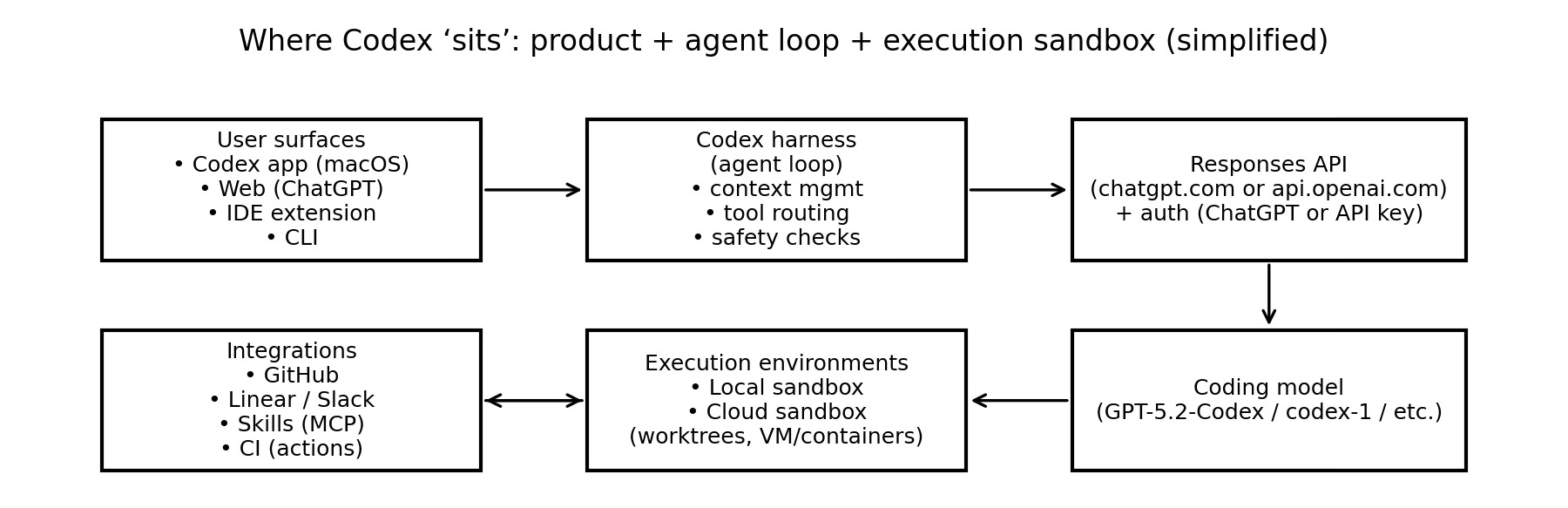
Codex sits between your intent and your repo/toolchain: it translates a natural-language task into an agent loop (plan → act → verify → summarize), executing inside sandboxes and integrating with Git/CI. The diagram below is a simplified view of the product surface area.
Representative Codex use cases (where an agent beats autocomplete):
Codebase modernization (framework upgrades, API migrations)
CI triage and flaky test reduction
Security fixes (patch known CVEs, scan/verify)
“Backlog draining” (small refactors, docs, lint, type fixes)
Code review as a safety net (catch issues early)
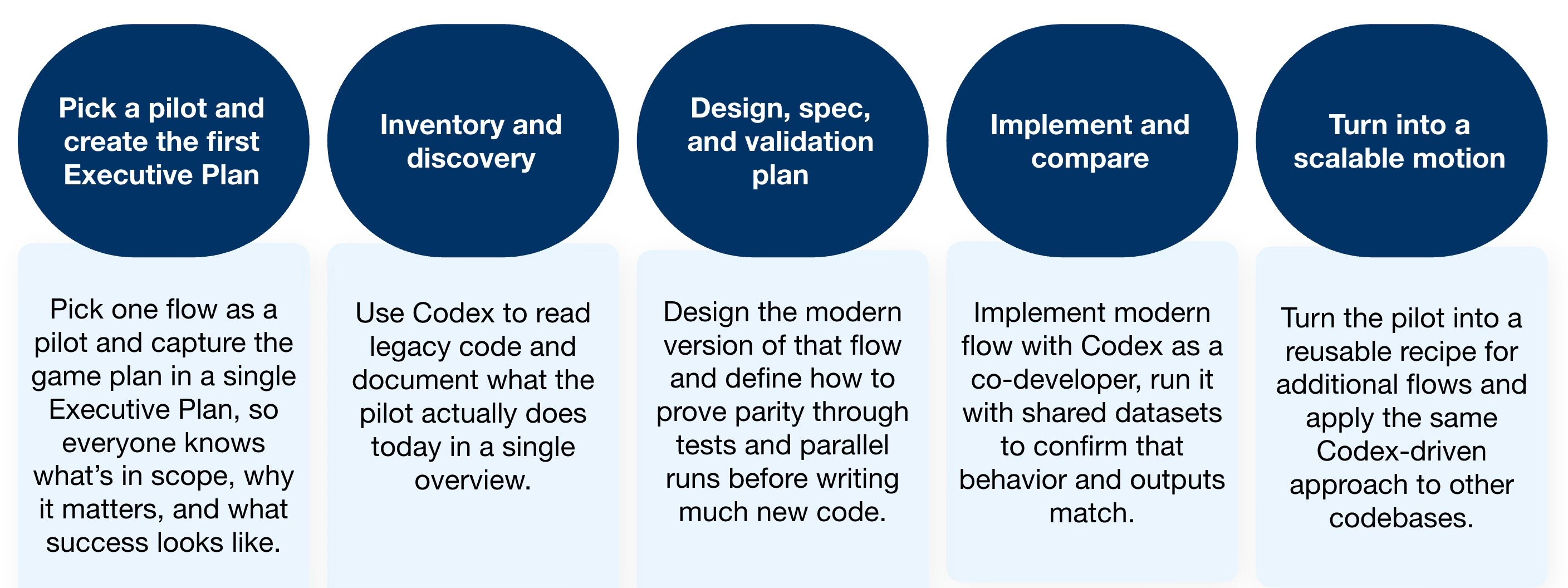
OpenAI’s own Cookbook emphasizes a phased approach for modernization, an example of agentic work where execution and verification matter.
Nature hates a vacuum
There is a convergence: (1) models can sustain longer-horizon reasoning and tool use, (2) secure sandboxing makes delegated execution palatable, and (3) developer culture is already adopting AI tools at scale. The blocking constraint was reliability under delegation. Autocomplete is forgiving; agents are not. Until recently, models were too error-prone to run unattended, and infrastructure for safe execution (isolated VMs, policy controls, audit trails) wasn’t productized for mainstream developers.
A quick category arc:
2021: Codex as a code-generation model (API), seed of the idea.
2022–2024: IDE copilots normalize suggestion-based assistance.
2025: Codex returns as an agentic product (cloud + open-source CLI), emphasizing sandboxed execution.
Dec 2025–Feb 2026: model specialization (GPT-5.2-Codex) + native app, pushing toward agent-complete.
Three enabling trends:
Agent harness design (explicit loops, tool routing, evaluation-driven iteration).
Sandboxed execution becoming default for agents (restrict network/files, require approvals).
Standardized integration patterns (e.g., MCP-style skills) so agents can use tools without bespoke glue each time.
A market hiding in plain sight
Primary customers:
Individual developers (self-serve) who want faster iteration.
Teams and engineering orgs (Business/Enterprise) who want throughput + governance.
Non-engineers in product/design/ops who can now safely ship small changes.
The market is agentic software delivery. Tools that can execute chunks of the SDLC under human supervision.
Codex is an attempt to re-draw the category boundary: from assistive coding to delegated engineering. The unit of value shifts from tokens or completions to outcomes (merged PRs, fixed bugs, reduced review load).
Codex’s sweet spot is the practitioner who:
Works in a repo with tests/CI (verification matters).
Juggles multiple parallel tasks (context-switching is expensive).
Cares about safety and traceability (especially in enterprise).
Codex also expands the reachable user base: designers/PMs can delegate small code in controlled environments.
Everyone wants the keyboard
Direct competition (AI coding agents/assistants): GitHub Copilot (agent mode), Cursor, Anthropic Claude (Claude Code), Google Gemini Code Assist.
Indirect alternatives: traditional IDEs + human processes (pair programming, code review, scripting, outsourcing), and platform agents that can code but aren’t specialized for repos.
A coherent plan to win for Codex has three pillars:
Model advantage for software engineering tasks (specialization + evals).
Agent harness advantage (reliability, safety, and UX for steering).
Distribution advantage via ChatGPT (hundreds of millions of users) plus an open-source CLI that keeps Codex close to developers.
Put differently: Codex must be better at the unsexy parts: running tests, handling CI, producing reviewable diffs, and operating safely.
Codex advantages (as positioned by OpenAI’s recent shipping):
Deep integration with ChatGPT plans + identity (fast distribution).
Open-source CLI and skills ecosystem (developer trust + extensibility).
Safety model: sandboxing, approvals, and documented risk controls.
Parallel task execution + review workflows.
Key risk: incumbents own the IDE surface; Codex must be compelling enough that teams tolerate context switching.
Where Codex lives
Form factors (Feb 2026):
Codex app (macOS): native command center for agent work.
Web (ChatGPT/Codex): run tasks, review diffs, purchase credits.
CLI (open source): run Codex from terminal; authenticate via ChatGPT; integrate into dev workflows.
IDE extension (VS Code) + integrations (GitHub Actions, Slack/Linear patterns via skills).
Functionality highlights:
Parallel tasks; repo-aware edits; test execution in sandboxes; code review mode.
Skills via MCP: connect to external tools/services.
Architecture/IP:
Proprietary: the models (e.g., GPT-5.2-Codex / codex-1) and much of the service backend.
Open source: Codex CLI + supporting repositories, enabling community contributions and trust.
Explicit roadmap signals from OpenAI’s public materials:
Expand Codex app to more platforms over time (macOS is the first).
Continue improving the agent harness (reliability, steering, collaboration).
Expand availability across plan tiers (temporary inclusion in Free/Go; credits for overflow).
Tighten the feedback loop between evaluations and shipping (system cards + addenda).
Key open questions (watch items): background execution concurrency limits, enterprise admin controls, and first-class issue-tracker integrations.
How the machine pays for itself
Codex monetizes as part of a broader platform strategy: subscriptions (Plus/Pro/Business/Enterprise) that bundle high-value tools, and pay-as-you-go credits for burst usage beyond included limits. The open-source CLI functions as both distribution and trust infrastructure.
Primary revenue levers:
Subscription uplift: Codex increases conversion/retention for Plus/Pro and seat adoption for Business.
Credits: users can buy additional credits when they hit usage limits, rather than switching tools or upgrading immediately.
API pull-through: Codex CLI links a ChatGPT account to an API organization; OpenAI explicitly encourages redeeming API credits and connecting accounts.
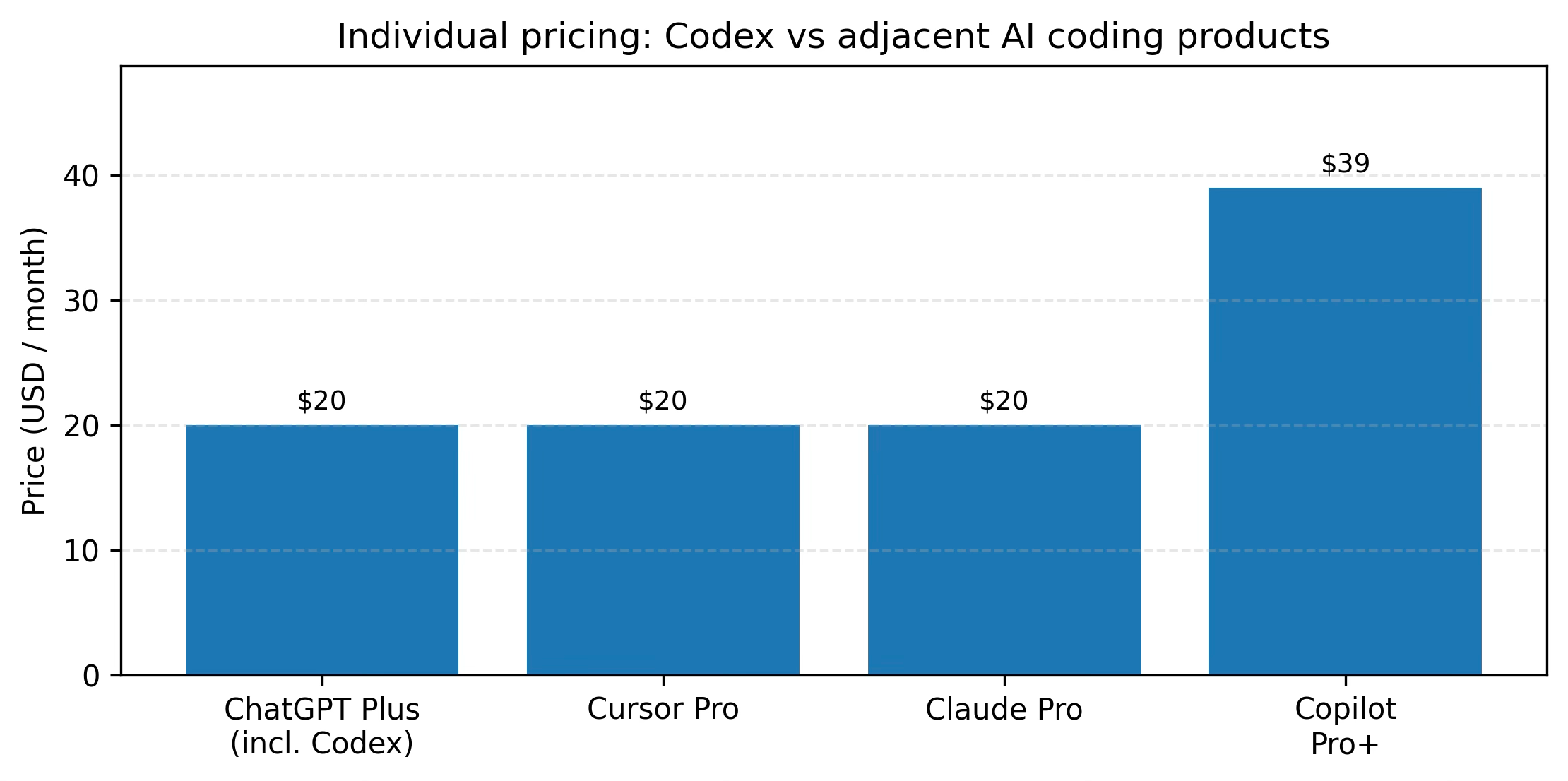
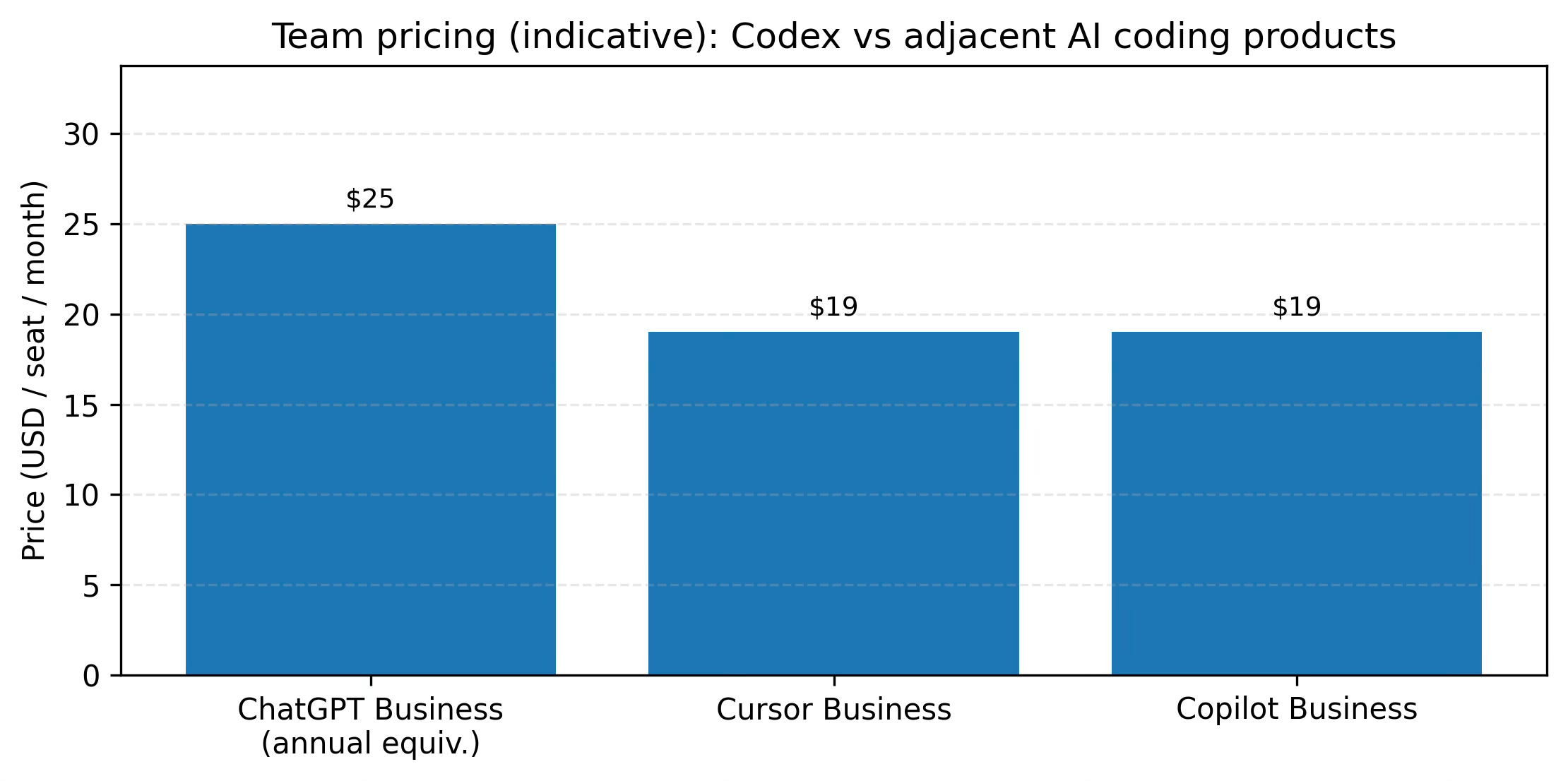
Codex is bundled across ChatGPT plan tiers, with overflow handled via credits. OpenAI’s public pricing anchors include: Plus $20/month; Pro $200/month; Business $25/seat/month billed annually ($30 monthly).
Distribution channels:
Self-serve via ChatGPT plans (fast adoption).
Enterprise sales for Enterprise/Edu (governance, procurement).
Developer-led growth via open-source CLI + GitHub integrations.
Partnerships via tool ecosystems (e.g., JetBrains MCP).
Software, after the agent
A plausible 5-year Codex endgame (consistent with OpenAI’s public trajectory):
Codex becomes an always-on engineering collaborator: it watches repos, proposes PRs, and continuously reduces technical debt.
Skills and automations become team-standard primitives, your org ships reusable agent workflows the way it ships internal libraries today.
Review becomes the primary human bottleneck; Codex optimizes for producing reviewable, test-backed diffs and for explaining tradeoffs.
Governance is native: policy, audit logs, and sandboxed execution are default, making agentic engineering acceptable in regulated industries.
The product feels like a control system for software delivery: queue work, set guardrails, and approve outcomes.
Sources
OpenAI — Introducing the Codex app. 2026-02-02. https://openai.com/index/introducing-the-codex-app/.
OpenAI — Introducing Codex. 2025-05-16. https://openai.com/index/introducing-codex/.
OpenAI — Unrolling the Codex agent loop. 2026-01-23. https://openai.com/index/unrolling-the-codex-agent-loop/.
OpenAI Developers — Codex documentation (Skills & MCP). n.d.. https://developers.openai.com/codex/.
OpenAI — OpenAI Charter. 2018-04-09 (updated periodically). https://openai.com/charter/.
Software Engineering Daily — OpenAI and Codex with Thibault Sottiaux and Ed Bayes (transcript). 2026-01-29. https://softwareengineeringdaily.com/wp-content/uploads/2026/01/SED1898-OpenAI.txt.
OpenAI — OpenAI o3 System Card Addendum: GPT-5.2-Codex. 2025-12-18. https://cdn.openai.com/pdf/ac7c37ae-7f4c-4442-b741-2eabdeaf77e0/oai_5_2_Codex.pdf.
OpenAI Developers — Codex documentation (App features). n.d.. https://developers.openai.com/codex/features/app/.
Dev Interrupted (LinearB) — Scaffolding is coping not scaling, and other lessons from Codex. 2026-01-27. https://linearb.io/dev-interrupted/podcast/openai-codex-thibault-sottiaux-agentic-autonomy.
OpenAI Developers — Modernizing your Codebase with Codex (Cookbook). n.d.. https://developers.openai.com/cookbook/modernizing-your-codebase-with-codex/.
OpenAI Developers — Codex documentation. n.d.. https://developers.openai.com/codex/.
Stack Overflow — 2025 Stack Overflow Developer Survey. 2025. https://survey.stackoverflow.co/2025/.
OpenAI — Introducing OpenAI Codex. 2021-08-10. https://openai.com/index/openai-codex/.
OpenAI — GPT-5.2 in ChatGPT. 2025-12-11. https://openai.com/index/gpt-5-2-in-chatgpt/.
OpenAI Developers — Supercharging Codex with JetBrains MCP at Skyscanner. n.d.. https://developers.openai.com/blog/supercharging-codex-with-jetbrains-mcp-at-skyscanner.
SlashData — Developer Population Sizing (Updated Q3 2025). 2025 (updated Q3). https://www.slashdata.co/research/developer-population.
JetBrains — How Many Developers Are There in the World? (Data Playground). n.d. (estimates through 2025). https://www.jetbrains.com/lp/devecosystem-data-playground/.
OpenAI — Introducing ChatGPT Team. 2024-01-10. https://openai.com/index/introducing-chatgpt-team/.
OpenAI — Introducing ChatGPT Go, now available worldwide. 2026-01-16. https://openai.com/index/introducing-chatgpt-go/.
GitHub Docs — GitHub Copilot licenses. n.d.. https://docs.github.com/en/billing/concepts/product-billing/github-copilot-licenses.
Cursor — Cursor Pricing. n.d.. https://cursor.com/pricing.
Anthropic — Claude plans & pricing. n.d.. https://claude.com/pricing.
Google — Gemini Code Assist | AI coding assistant. n.d.. https://codeassist.google/.
OpenAI — openai/codex (GitHub repository). n.d.. https://github.com/openai/codex.
GitHub — GitHub Copilot plans & pricing. n.d.. https://github.com/features/copilot/plans.
OpenAI Developers — Codex Changelog. n.d.. https://developers.openai.com/codex/changelog/.
OpenAI Developers — Codex Pricing. n.d.. https://developers.openai.com/codex/pricing/.
OpenAI Help Center — Using Codex with your ChatGPT plan. 2026 (updated frequently). https://help.openai.com/en/articles/11369540-using-codex-with-your-chatgpt-plan.
OpenAI — Introducing ChatGPT Pro. 2024-12-05. https://openai.com/index/introducing-chatgpt-pro/.
OpenAI Help Center — Using Credits for Flexible Usage in ChatGPT. n.d.. https://help.openai.com/en/articles/12642688-using-credits-for-flexible-usage-in-chatgpt-freegopluspro-sora.
OpenAI Help Center — What is ChatGPT Business?. n.d.. https://help.openai.com/en/articles/8792828-what-is-chatgpt-team.
Reuters — OpenAI projected least 220 million people will pay ChatGPT by 2030 (reported by Reuters/The Information). 2025-11-26. https://www.reuters.com/technology/openai-projected-least-220-million-people-will-pay-chatgpt-by-2030-information-2025-11-26/.
OpenAI — OpenAI pricing (ChatGPT plans). n.d.. https://openai.com/pricing/.
OpenAI Developers — Codex documentation (Automations). n.d.. https://developers.openai.com/codex/features/automations/.