

Alphabet is using AI to extend its old task of helping people find, use, and act on information at world scale. AI is now the platform shift that ties together its infrastructure, research, and the products that reach billions of people. A stack that runs from TPUs in data centers to Gemini models, then out through Search, Workspace, Cloud, Chrome, Youtube, and the Gemini app.
People face more data than they can sort, and firms keep key knowledge split across mail, docs, tickets, code, and line-of-business apps. Old search gives links but weak help with long tasks, while first-wave AI chat tools gave drafts but sat apart from the systems where work gets done. In the office, that split blocks use, since an answer tool without access to context, roles, or systems is less useful and trustworthy. On the web, the same same gap shows up when a user wants to move from asking a question to buying a ticket, making a booking, or carrying a plan through to the end.
Alphabet’s answer is to join retrieval, reasoning, action, and distribution inside one stack. At the base sit custom TPUs, GPUs, and the data-center estate that trains and serves Gemini. Above that sit Vertex AI, the Gemini API, and Gemini Enterprise. Above that sit the product surfaces where demand lives already, above all Search, Workspace, and the Gemini app. Search now moves from AI Overviews into AI Mode, where users can keep the thread of a question and, in some cases, hand a task to agent software while they stay in control. In the office, Gemini Enterprise connects tools such as Confluence, Jira, Sharepoint, and ServiceNow, so the model can work with the firm’s own graph of knowledge. The value in that design is durable, since each model gain can move across consumer use, developer work , and enterprise seats in one push.
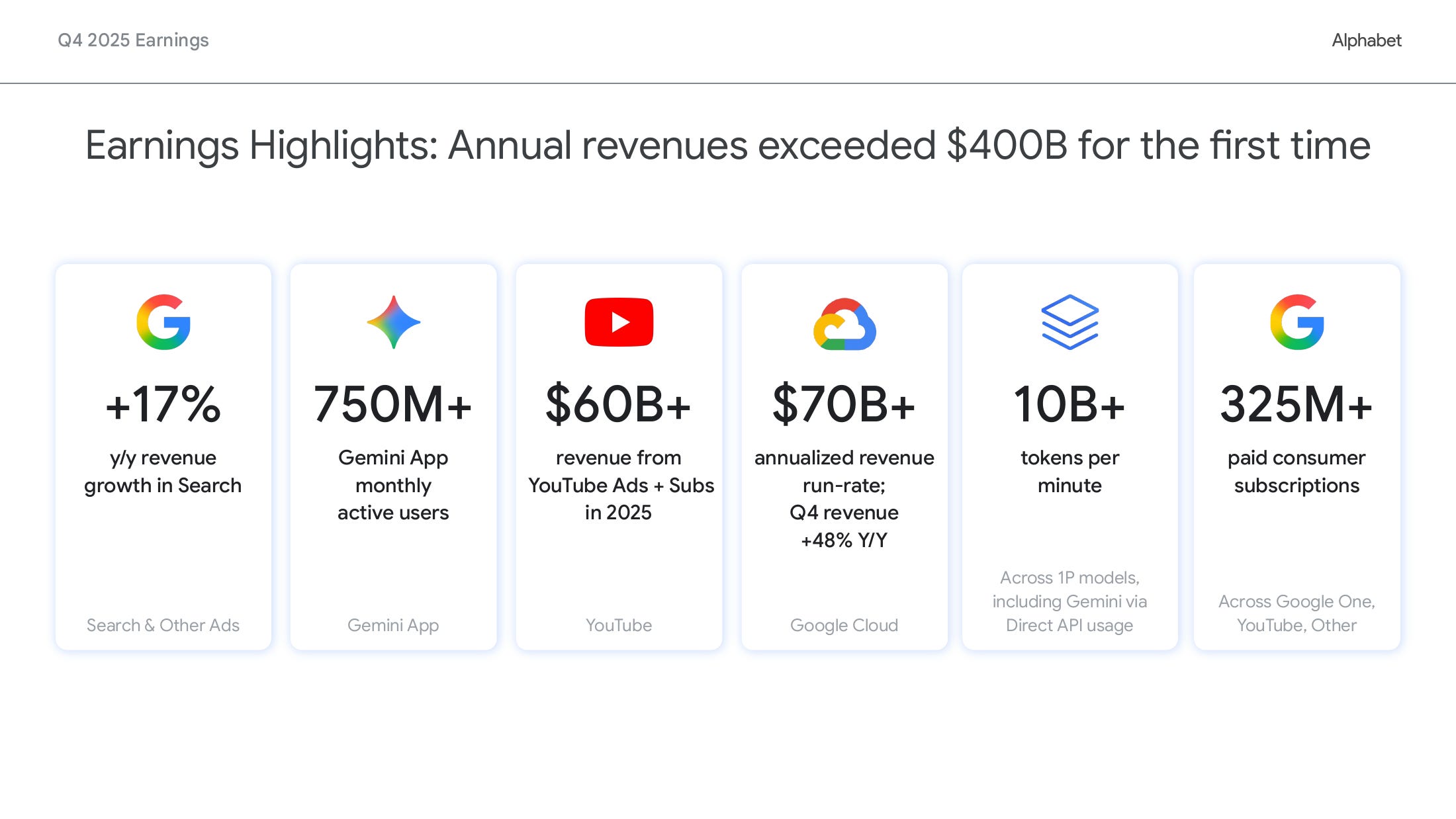
By February, Gemini customer API traffic had passed 10 billion tokens per minute, Gemini Enterprise had sold more than eight million paid seats in four months, and the Gemini app had moved past 750 million users each month. Gemini serving unit costs fell 78% through 2025, which changes what can be put into a search page, a mail draft, or a coding loop without wrecking unit economics. Search offers proof that behavior has shifted as well. AI Overviews had reached more than 1.5 billion users by May 2025 and 2 billion users each month by late 2025, and Google said the queries that show them were driving over 10% growth in major markets.
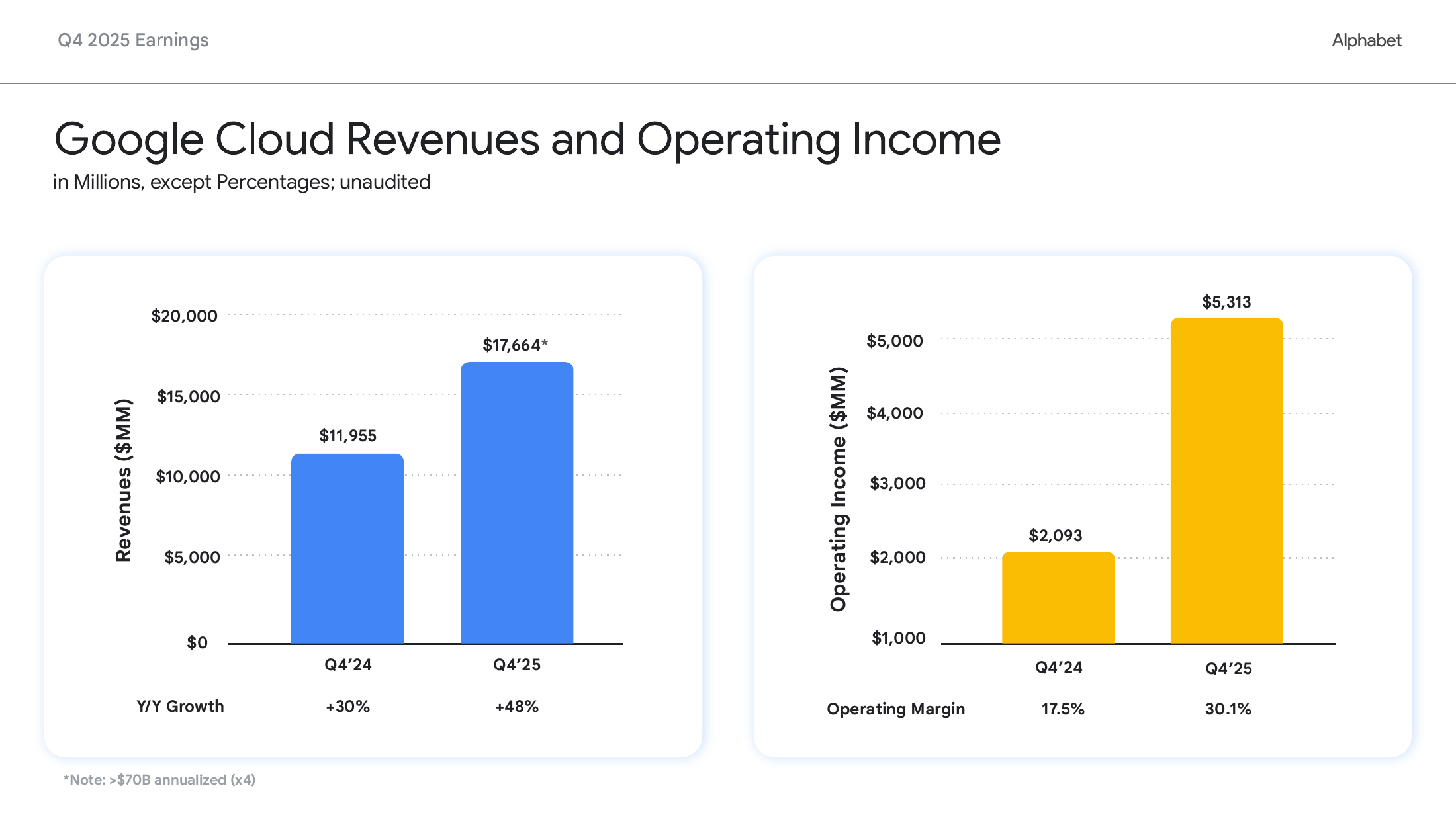
Gartner puts 2026 AI spend at $2.53 trillion, with AI infrastructure at $1.37 trillion, AI services at $589 billion, and AI software at $452 billion. A tighter serviceable market for Alphabet is the part where it has sellable product now, above all infrastructure, models, developer platforms, and workplace software. Using Gartner’s own categories, AI infrastructure, AI software, AI models, AI data, machine-learning platforms, and AI app-development platforms add to about $1.89 trillion in 2026. The obtainable slice is harder to pin down because Alphabet does not break out AI revenue, yet the public floor is large. Google Cloud ended 2025 at a run rate above $79 billion, and Synergy put Google at 14% of the cloud infrastructure market in the last quarter of 2025, with genAI as the main growth driver.
Competition is dense at each layer. Microsoft pitches Foundry as a unified app and agent factory with more than 11,000 models, Amazon Bedrock offers managed access to more than 100 foundation models, Claude Enterprise sells secure access to firm knowledge, and ChatGPT Enterprise sells a work suite with search, deep research, data analysis, and other native tools. Alphabet’s path to a win rests on fit across the whole route from chip to user. It owns large demand surfaces in Search, Chrome, Android, YouTube, and Workspace, and it can move model gains into those surfaces while it sells the same stack through Cloud. The cost drops in serving, the custom TPU base, and the web-grounded nature of Search give it a way to defend that route even as model gaps open and close.
For consumers there is the Gemini app, AI Mode in Search, Flow, Whisk, NotebookLM, and Gemini inside Gmail, Docs, Slides, Sheets, and Meet, sold through Google AI plans with tiered access to models and tools. For developers there are Gemini API, AI Studio, Gemini CLI, Code Assist, and Antigravity, with Gemini 3.1 Pro and 3.1 Flash-Lite rolling out across consumer, developer, and enterprise entry points. For firms there are Vertex AI, Gemini Enterprise, Cloud Assist, and Workspace plans that include Gemini features in seat licenses. Each new model release can spread through many products at once, while each product surface feeds demand back into the stack.
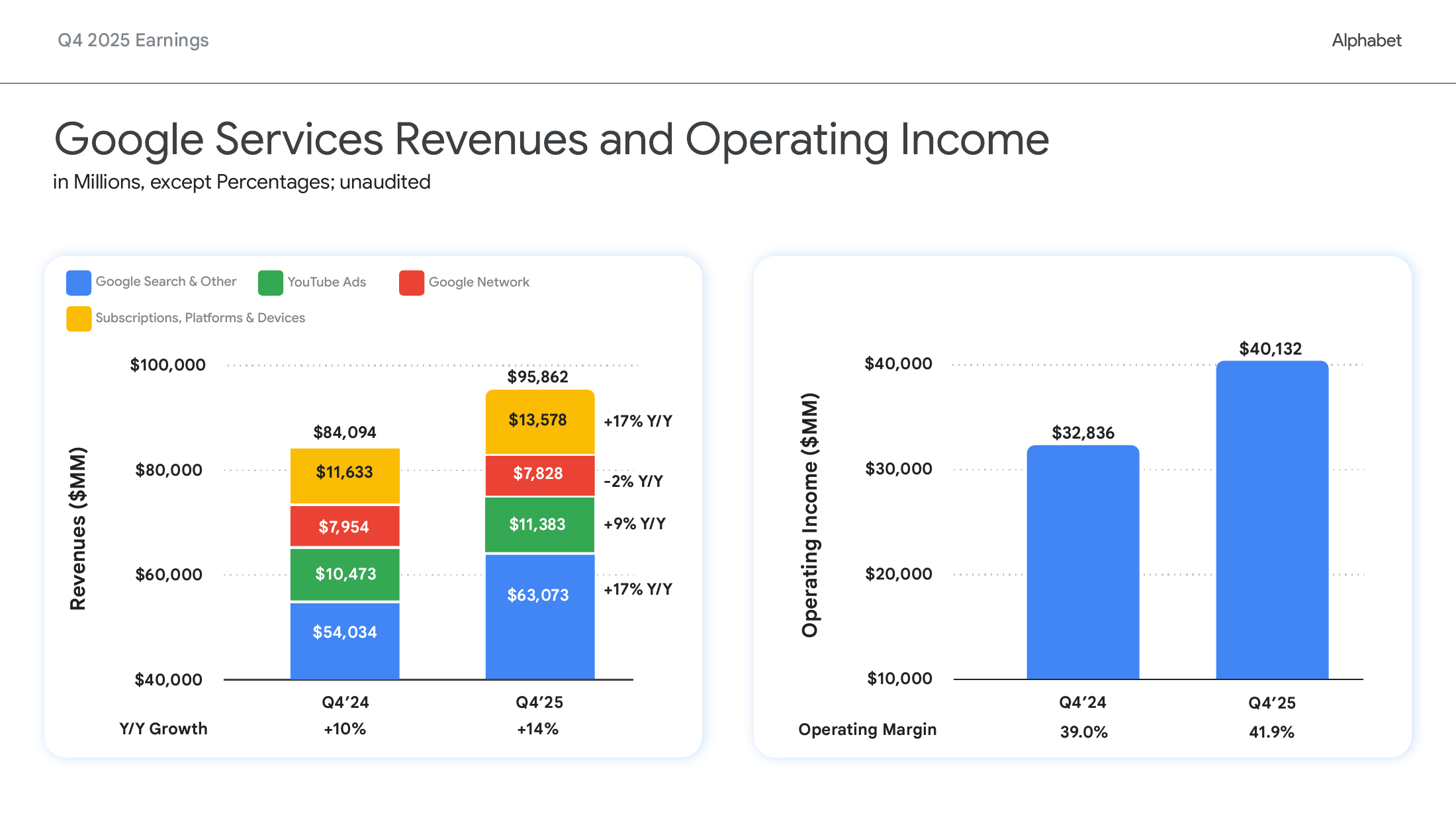
The revenue model has four legs. Ads still fund the free side of Search and other consumer products, consumer plans add subscription spend, and Cloud bills by use or seat. APIs turn model output into metered spend through Gemini pricing tiers. Consumer pricing now runs up to Google AI Ultra, with Ultra at $249.99 a month in the U.S., while Workspace business plans run from $8.40 to $26.40 per user a month on the flexible schedule and higher tiers fold in broader Gemini use. Developers can buy in at token rates, with Gemini 3.1 Flash-Lite priced at $0.25 per million input tokens and $1.50 per million output tokens, while Gemini Code Assist Enterprise is sold on subscription terms. Alphabet does not disclose a clean AI account size or lifetime value, but it does disclose enough to show traction, from more than eight million paid Gemini Enterprise seats to customer wins such as Figma, Klarna, and Mercedes.
Sundar Pichai sets the frame, with AI cast as the biggest platform shift in decades and as a company-wide project that joins product, research, and infrastructure. Demis Hassabis carries the research brief at Google DeepMind, Thomas Kurian turns the stack into enterprise product and sales motion, and James Manyika holds the brief for research, labs, and the social frame around responsible use. That split is one reason Alphabet can run science, consumer software, and enterprise go-to-market in parallel without folding all of them into one lab or one sales group. The new Platform 37 hub in London is a neat sign of intent, since Google DeepMind and Google teams will move in together to keep the research engine close to product work.
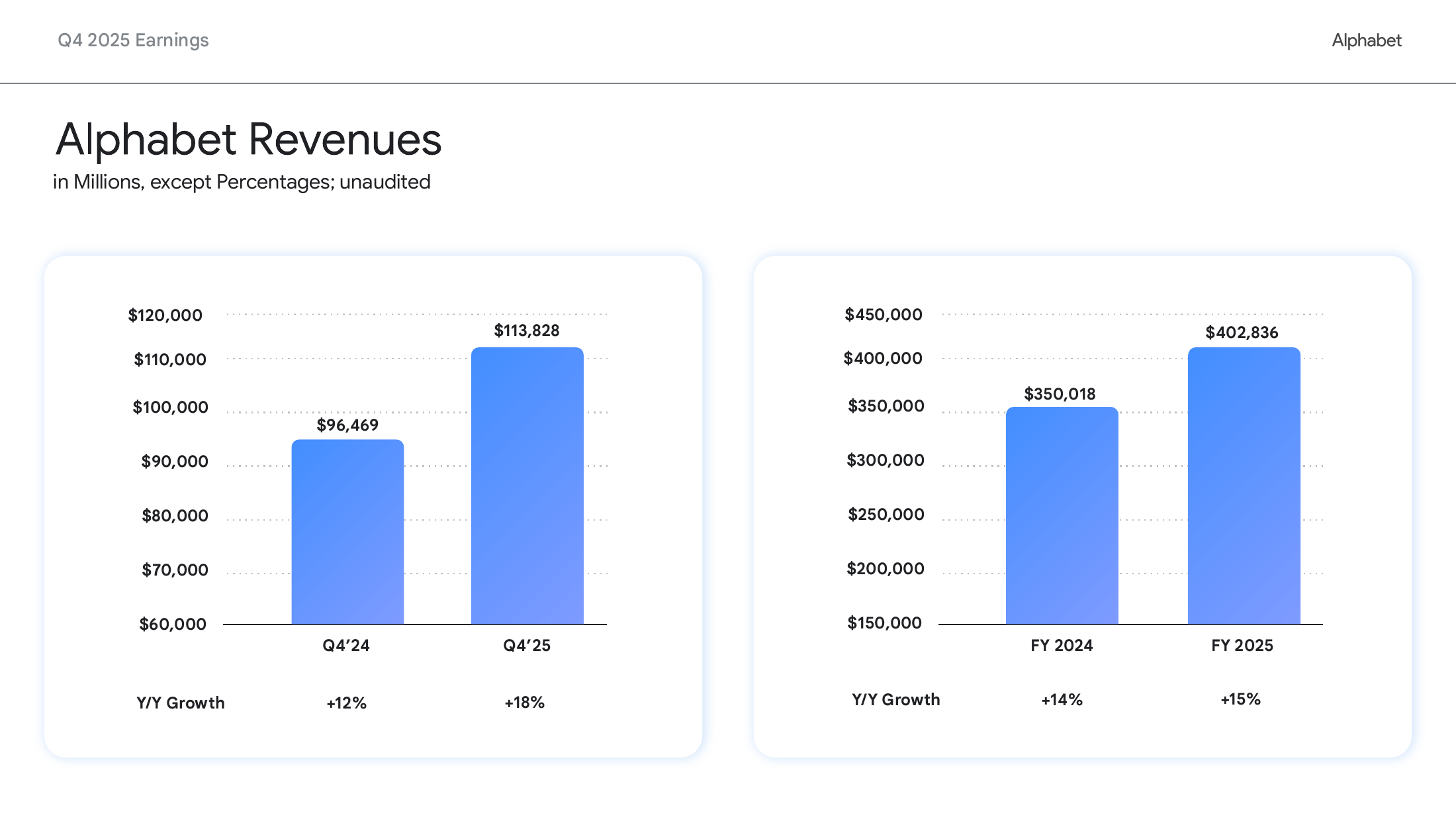
Alphabet closed 2025 with $402.8 billion in revenue, $129.0 billion in operating income, $58.7 billion in Google Cloud revenue, $13.9 billion in Google Cloud operating income, $126.8 billion in cash and marketable securities, $595.3 billion in assets, and $164.7 billion in cash flow from operations, while property and equipment spend reached $91.4 billion as the firm built out technical infrastructure. Those figures describe an AI company with the balance sheet to fund its own shift. Five years out, the build points toward an Alphabet where AI is the operating layer across search, browsing, work software, developer tools, cloud, and parts of science itself. That future is still an inference, and rivals will press on price, models, and trust. In any case, Alphabet’s AI business is operating as a system with real scale.