

Basis builds AI agents that execute accounting workflows end-to-end for accounting firms, with humans reviewing and signing off on the final work product. The company positions itself as the next era of accounting and organizes its product around the core practice areas of a modern firm: client accounting services (CAS), tax, audit, and advisory. Their end-to-end execution, reviewability, and firmwide deployment suggests it wants to become the layer where accounting work is planned, executed (by agents), and audited (by humans) across the firm.
Too Much Work, Too Few Accountants
There is more accounting work than the industry can comfortably staff, and the work is getting harder as data volumes grow and rules proliferate.
Firms throw people at it (overtime during tax season, hiring, contractors), push work down the cost curve (offshoring, outsourcing), and patch the workflow with point tools (OCR, AP automation, close checklists, practice management software). In parallel, many teams experiment with general-purpose AI chat tools - but those tools usually sit outside the system of record and outside the audit trail.
Accounting is structured, but it is not uniform. Engagements vary by client, by year, and by firm policy; errors are high-stakes. Tools that produce answers without a traceable path create a new kind of risk: faster output with weaker defensibility.
From Prompts to Delegation
Basis’ solution is to treat accounting as a set of workflows that can be delegated to software agents. The product should run in the background and return finished, review-ready work - the way a junior staffer would - rather than force accountants to prompt, copy, paste, and translate outputs between tools.
Basis markets agents built specifically for accountants across CAS, tax, audit, and advisory. Agents execute workflows end-to-end and update at key stages, with finished output delivered ready for review.
Basis uses a multi-agent system with a supervising agent that routes work to specialist agents, and it relies on model progress (and internal evaluation) to expand the set of tasks agents can do reliably.
Basis is trying to own the workflow layer - the combination of tool access, firm-specific standards, and traceability that turns raw model capability into something a partner can sign. If that layer becomes the system of record for how work gets done, switching costs rise with every engagement, template, and reviewer habit that gets encoded.
The company sees a path beyond public accounting into corporate finance functions. The agent framing also naturally expands from producing artifacts (a reconciliation) to managing processes (a close).
Basis highlights high-friction work that is too structured for pure chat and too variable for brittle automation. They point to completing a partnership tax workbook end-to-end, creating complex journal entries, debugging reconciliations, and drafting technical accounting memos.
Use cases: (1) client accounting services - reconciliations, journal entries, month-end close support; (2) tax - workpapers and partnership tax workbooks; (3) audit - evidence gathering and structured analysis; and (4) advisory - technical memos and client-ready summaries.
Basis is an overlay platform that connects to the firm’s accounting systems and documents, runs a workflow via agents, and then hands back outputs plus an explanation trail for human review.
The Stack Finally Compounded
Modern models became capable of multi-step, tool-using work, and accounting firms hit a breaking point on capacity. The category has had automation for decades, but it was mostly rules and templates: OCR to extract fields, RPA bots to move data, and checklist software to coordinate humans. Those tools work best when the world is consistent. Accounting work is structured, but the edge cases are infinite - which is exactly where older automation breaks.
What changed is less a single breakthrough than a compounding stack: models that can reason across long contexts, call tools, and be evaluated against domain-specific benchmarks; plus cloud software and APIs that make accounting data accessible enough to automate safely. Basis route tasks across models and rely on model progress to expand capability.
Basis sums up the moment neatly: “Intelligence is becoming abundant. Putting it to work remains hard.” That ‘remains hard’ is the business opportunity - turning raw model outputs into reliable, reviewable work inside conservative organizations.
The industry incentives are also finally aligned. A shrinking CPA pipeline (AICPA) and continued demand for accountants (BLS) push firms to find leverage that does not depend on hiring alone. Meanwhile, firms are now comfortable buying cloud software that touches sensitive data - provided security and audit controls exist.
The Market Is Accounting Work
Enormous, recurring, and painfully process-heavy. The practical near-term market for Basis is the slice of that work that can be turned into software through repeatable workflows and trusted supervision.
Basis is aimed first at public accounting firms - the partners and managers who are responsible for quality, deadlines, and margin, and the staff who live inside reconciliations, workpapers, and year-end packages. The product taxonomy (CAS/tax/audit/advisory) is basically a map of a firm’s P&L.
Instead of accounting software (a mature category), the company is positioning itself as an AI labor layer that sits on top of existing systems.
Basis shows public accounting firm logos including Armanino, Berkowitz Pollack Brant, Boulay, Clark Nuber, MarksNelson, Pinion, UHY, WilkinGuttenplan, and Wiss.
Basis is building agents used by top accounting firms including Armanino, Berkowitz Pollack Brant, Boulay, Clark Nuber, MarksNelson, Pinion, UHY, WilkinGuttenplan, and Wiss. The initial wedge is the higher-end of the market where the ROI of leverage is easiest to prove.
Basis does not publicly disclose pricing. Below is a scenario-based sizing that separates what we can source (industry revenue, employment) from what we must assume (software spend share, ARPU, adoption).
The top-down TAM is bounded by what the industry actually earns, and the bottom-up SAM is bounded by how many accountants are plausibly in-scope for an agent subscription.'The real question is not whether the market is big, but whether Basis can capture a durable slice.
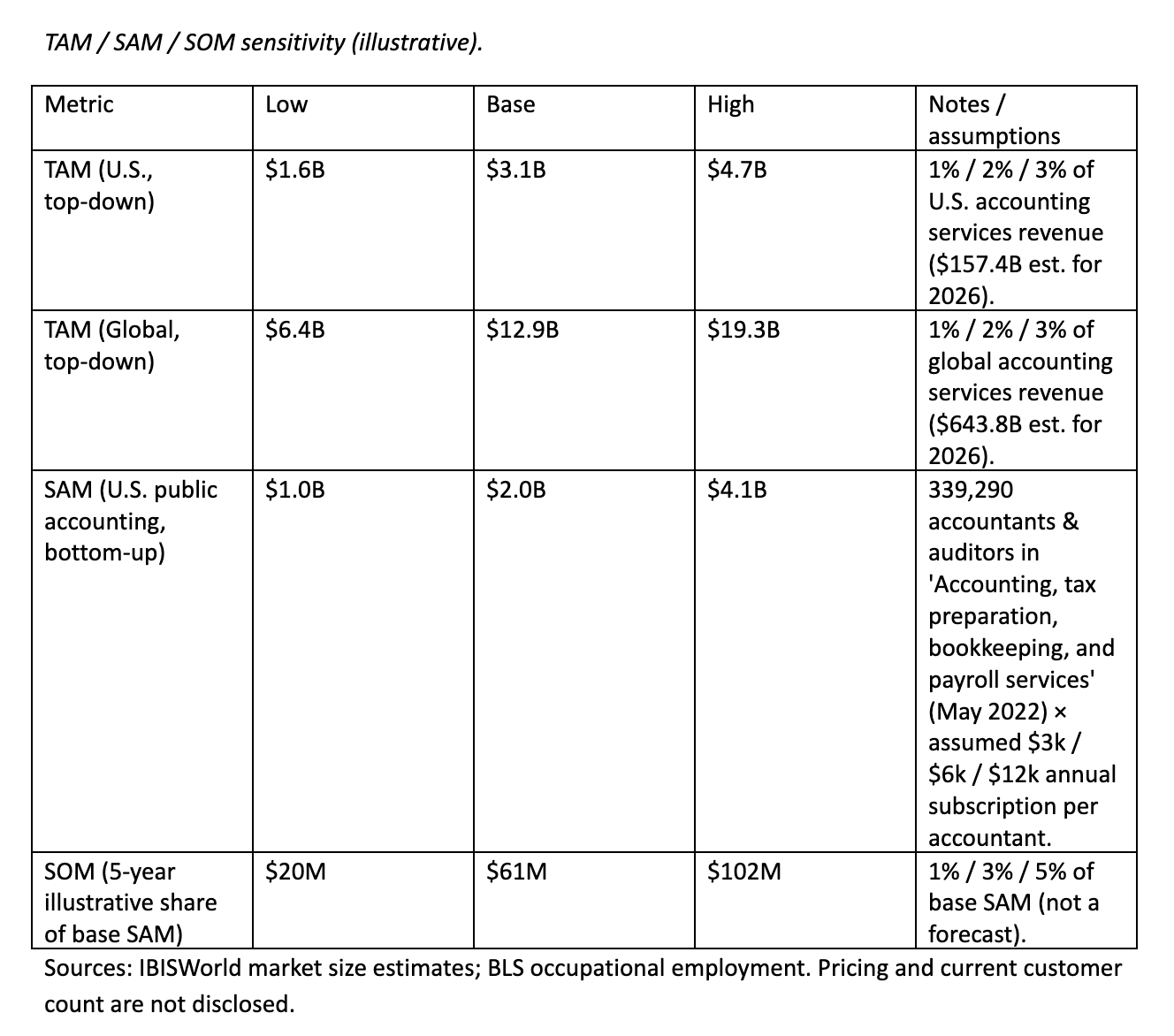
The underlying services market is huge: ~$157B (U.S.) and ~$644B (global) accounting services revenue (IBISWorld estimates). A plausible near-term SAM for a public-accounting-focused agent subscription can still be $1-4B, depending mostly on pricing and seat coverage assumptions. SOM is an execution question: distribution into firms, trust, and retention matter more than raw market size.
The Real Competitors: Spreadsheets + Offshoring
Basis competes in a crowded software landscape, but the real alternatives customers use day-to-day are older and cheaper: spreadsheets, checklists, offshore labor, and incremental automation inside existing accounting suites.
Direct competition (closest shape): other AI-first workflow tools aimed at automating accounting deliverables, especially for public accounting firms and finance teams. Indirect: incumbent accounting platforms (e.g., bookkeeping/GL and tax/audit suites) adding AI features; and horizontal copilots that improve writing and lookup but don’t own the workflow.
Wiss’s public comparison is telling: they described having a “private ChatGPT” instance with firm data and finding Microsoft Copilot useful - but still pursuing Basis because they wanted end-to-end automation that is embedded in the firm’s workflow rather than bolted on.
Basis’ stated plan to win is implicit in what it ships: (1) go deep on accounting-specific workflows (CAS/tax/audit/advisory), (2) make outputs reviewable and defensible (audit trail, security posture), and (3) pair software with deployment so the tool actually changes how work gets done inside a firm.
Competitive advantages (what’s observable today): reference customers and partnerships with recognizable firms; a workflow-first product posture (runs in the background and returns review-ready output); and an explicit security/compliance posture designed for sensitive financial data.
A Multi‑Agent Platform for Firms
Basis’ product is best understood as a multi-agent automation platform packaged for accounting firms: practice-area modules on top of an agent core, wrapped in security controls and shipped with a deployment function. Basis presents four practice-aligned modules - CAS, Tax, Audit, and Advisory - suggesting the interface and workflows are tailored to how firms already segment work and accountability.
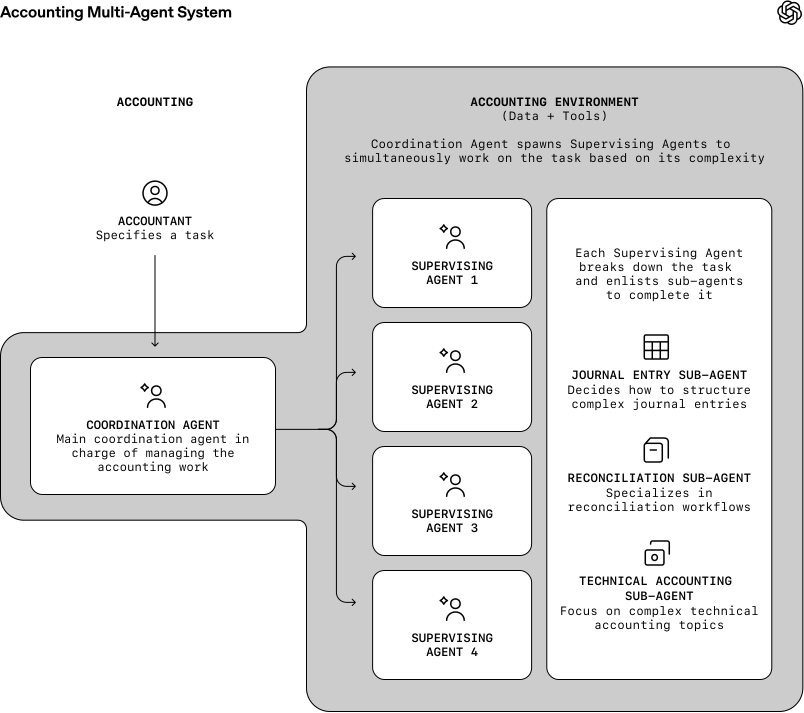
Basis is using a multi-agent architecture with a supervising agent and a set of sub-agents that handle different tasks; Basis routes work across models and emphasizes evaluation to make agents reliable. Agents execute workflows end-to-end and return review-ready output.
Enterprise controls and data handling are central to the product pitch. Basis doesn’t train or improve any AI model and has certifications/standards such as SOC 2 Type II and ISO 27001 (among others).
SaaS Priced Like Leverage
Basis is built to thrive as a high-value SaaS platform sold directly to accounting firms, with pricing anchored to labor leverage and delivered with deployment support. But the company does not publicly disclose pricing or revenue, so model mechanics are partly inferential.
The surface area suggests a subscription model (software platform access) and potentially services revenue via ‘Deployed Intelligence’ (implementation and workflow redesign).
The public website is demo-led (Get in touch/waitlist) rather than self-serve, which is consistent with enterprise or mid-market contract pricing rather than per-user checkout.
Customer acquisition appears relationship-driven (direct outreach + lighthouse firms), reinforced by public partnerships (e.g., Wiss) and platform credibility via the OpenAI case study.
The economic wedge is time. Basis can reduce time spent on work by up to 30%. If that time becomes billable capacity (or reduces overtime), pricing power follows.
Founder‑Led + Deployment‑Obsessed
Basis is founder-led and blend two muscles: deep AI engineering and the willingness to do deployment work inside conservative professional services firms. With Matt Harpe as CEO and Mitchell Troyanovsky as co-founder. Harpe worked in data science and strategy at Boston Consulting Group before founding Basis.
The team is betting that model capability has crossed a threshold where deployment effort compounds instead of resetting every time. Deployed Intelligence is the organizational tell. Basis doesn’t treat implementation as a necessary evil; it markets the function as a core competence and hires explicitly for agent managers - people whose job is to run and improve agent performance in production.
On the engineering side, the team writes about operating agents internally (e.g., Clueso for bug triage) and measuring incident outcomes. A useful signal of systems thinking and operational maturity.
Financials
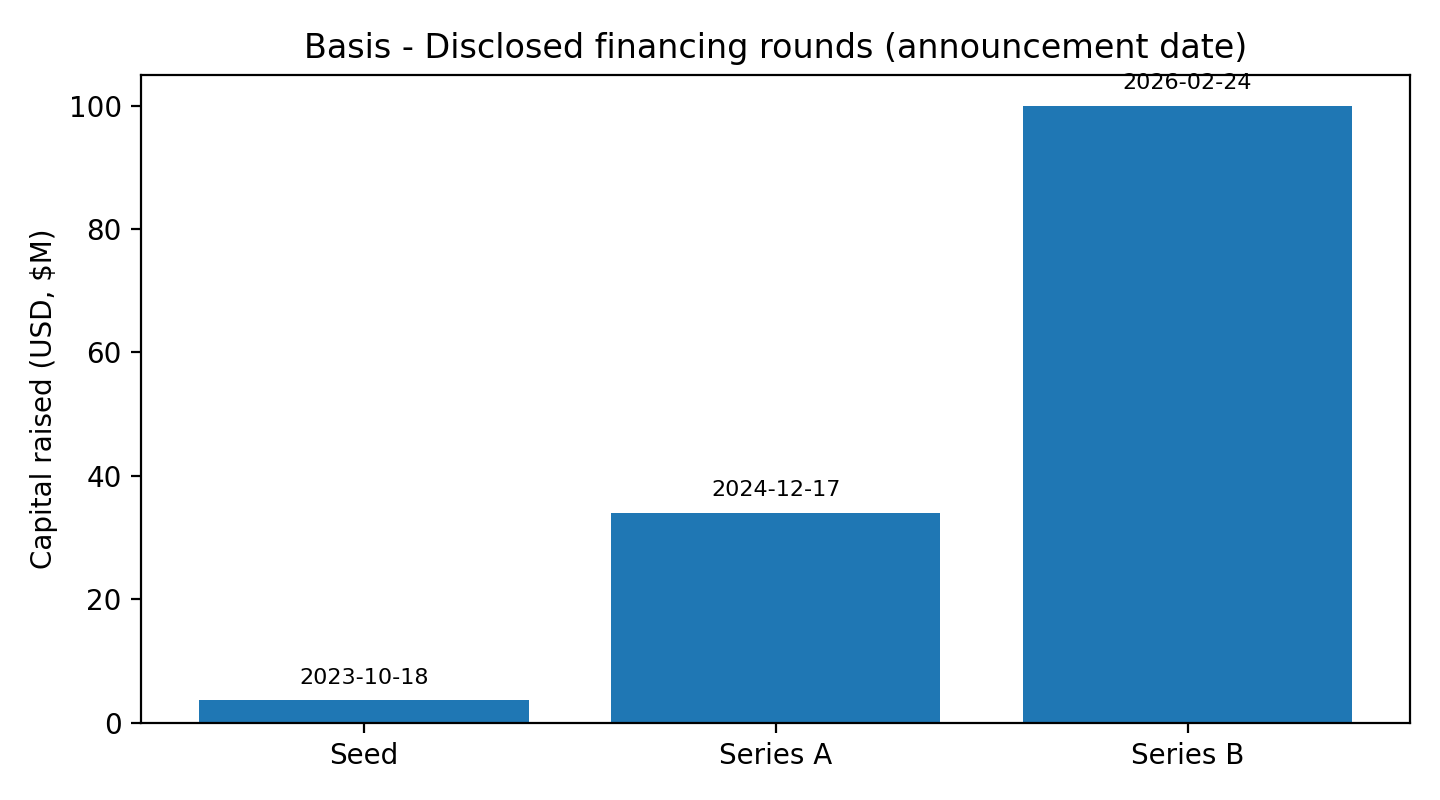
The only hard financial numbers in public relate to fundraising (capital raised) and, most recently, valuation. Basis recently raised $100M at a $1.15B valuation led by Accel and Google Ventures.
The Workflow Operating System
If all goes well, Basis becomes the system firms use to deploy, monitor, and audit an AI-enabled accounting workforce - not just a tool that helps with documents, but the place where workflows live and run.
Basis talks about building for a world where model capability keeps improving and where accounting firms need leverage to meet demand. The company frames this as building for the AGI era and expanding into new segments and organization types.
“AGI will come sooner than expected but take longer to diffuse.”
Translation: capability arrives quickly, but adoption is slow - which rewards companies that can package, deploy, and govern that capability inside real workflows.
In a base-case good outcome, Basis becomes a high-retention workflow platform inside a few hundred mid-to-large firms, expanding from artifacts (workpapers) into processes (close, tax season planning, audit execution). In a bull case, it becomes a category-defining layer that also penetrates in-house accounting teams, effectively turning capacity into a software product. In a bear case, it is outflanked by incumbents bundling similar agent workflows, or it fails on trust.
Inversion (how could this fail?): (1) agents make subtle mistakes that slip through review and cause client harm; (2) deployments stall because firms cannot change habits; (3) data access/integration remains brittle; (4) regulators or standard setters restrict AI use; (5) incumbents commoditize the feature set. (Most of these are trust-and-governance risks).